
Partnership Takes Delta Science to New Heights
April 22, 2026
By Dr. Lisamarie Windham-Myers
Earth Day is about environmental protection. The project highlighted in this blog captures how collaboration across sectors pooled funding to put that protection into action in California’s San Francisco Bay-Delta Estuary.
Inspired by the 1969 Santa Barbara oil spill and the resulting surge in environmental awareness, Earth Day has become synonymous with clean air, clean water, safe communities, and living in balance with the precious flora and fauna that share our planet. Many of the environmental protections we rely on today were created decades ago and were driven by science. To continue to protect what matters, we need more than good intentions – we need good information.
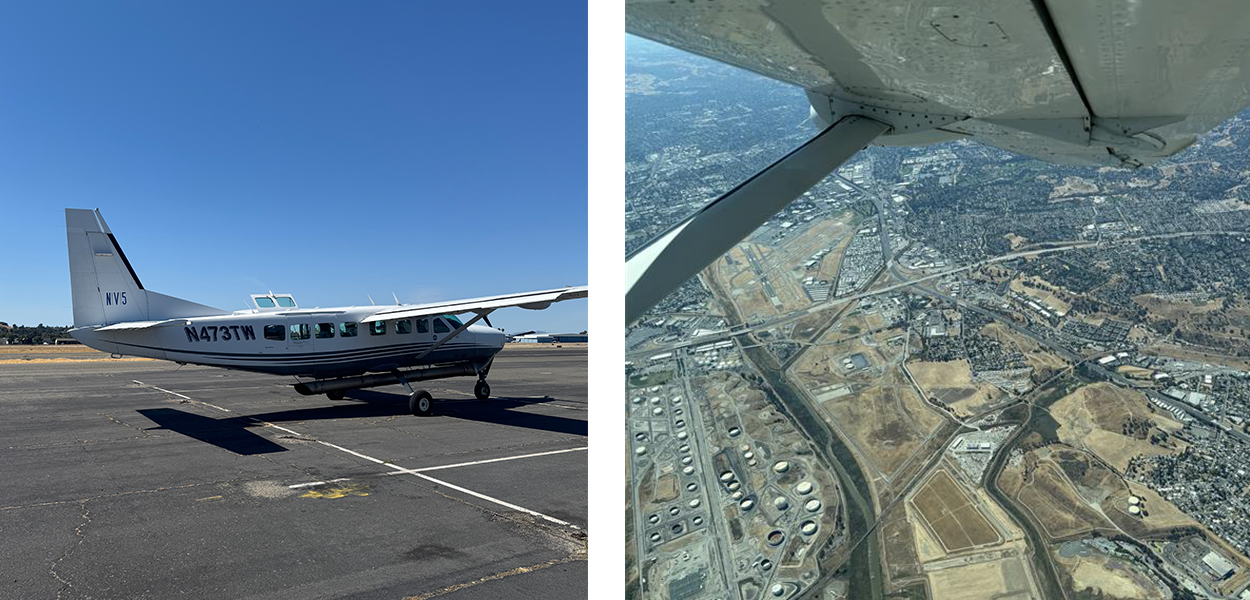
That commitment to scientific advancement brought together four public entities in 2025, including the Delta Stewardship Council. The Wetlands Regional Monitoring Program (WRMP), co-managed by the San Francisco Estuary Institute (SFEI) and San Francisco Estuary Partnership, proposed a major upgrade to the Bay-Delta’s mapping system and partnered with the Council and the Department of Water Resources (DWR) to scope and fund this unique and jointly-recognized opportunity. Together, we commissioned a comprehensive Light Detection and Ranging (lidar) survey of the Bay-Delta estuary by pooling resources and expertise to give the region something it has never had before: a single consistent, high-quality elevation map of the entire system. This shared data will facilitate collective problem-solving.
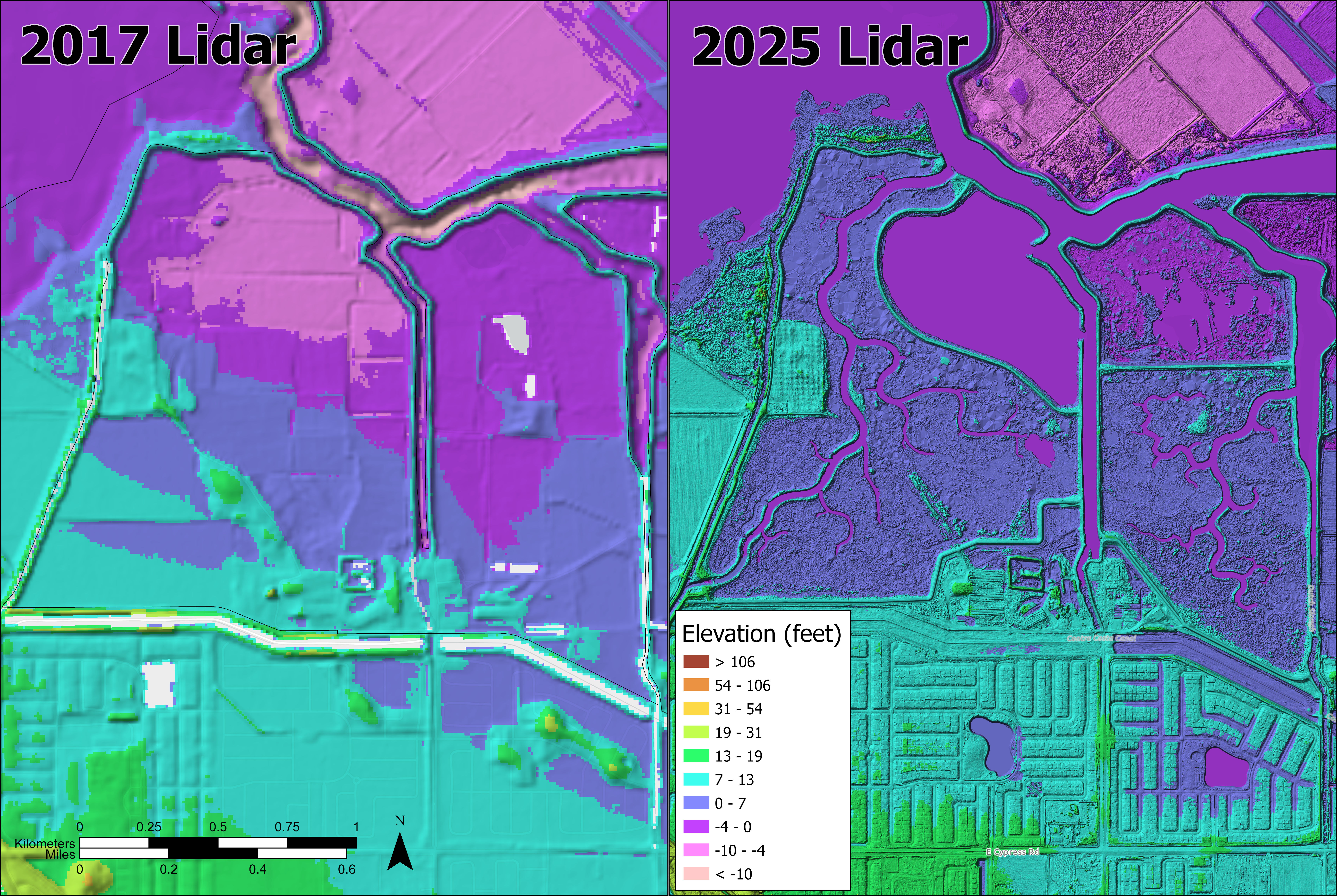
Lidar works a bit like radar, but instead of radio waves, it uses tiny pulses of light emitted and retrieved from an airplane. Those light pulses bounce off the ground and return to a sensor, which measures elevation with high precision. As a result, we will have a detailed, three-dimensional map of the entire Bay-Delta added to the USGS national map in 2027. Think of it like upgrading from an old flip phone camera to a modern smartphone camera. The picture becomes sharper, and the details become clearer. You can see details (i.e., drainage channels, trees, crops, and even potholes) that you could not see before.
Before this update, digital elevation model (or “DEM”) maps of the Bay-Delta were uneven. Some areas were mapped well, while others relied on older, less accurate data. Agencies often had to combine different datasets and make educated guesses about areas in between. Less guesswork and greater accuracy improve our ability to tackle flood protection, habitat restoration, and water management. Better data leads to better decisions for the Bay-Delta.
This new project replaces that patchwork map with one consistent, high-quality elevation map. It was collected during the summer of 2025, when water levels were lower, allowing scientists to capture more detail in river channels and wetlands, such as DWR’s Tule Red and Lookout Slough restoration sites. As well as replacing the patchwork of datasets with a single, consistent, high-quality map, the new seamless map's accuracy has improved. With 12 pulses per meter squared rather than the historical 3-8 pulses per meter squared, we have more data, allowing us to make out finer details vertically and horizontally. Depending on your needs, elevation maps can be generated at scales ranging from a few inches to 1 foot, respectively. That difference may not sound huge, but in a region where small elevation changes affect how water flows and whether restoration projects succeed, inches matter.
So what? What does this new map allow us to do better?
A more accurate elevation map helps scientists better understand how water moves through the Bay-Delta, where land is sinking, and where flood risks may increase. It improves computer models that predict how storms or sea level rise could impact communities. It also helps agencies plan ecosystem restoration projects more effectively and analyze the results of previous restoration projects. The Council, for example, has already started putting preliminary data to work in our climate and flood management initiatives, tracking land sinking and wetland recovery, improving flood maps, and more.
You can think of this dataset like a health checkup for the Bay-Delta. When doctors want to understand what is happening inside the body, they use tools like X-rays and scans. Digital elevation models are similar. When repeated year to year, it shows what is happening structurally across the landscape, so we can track changes over time and respond early to problems.
This matters for everyone. Better flood modeling helps protect homes and communities. More accurate water modeling supports clean drinking water. For instance, the data can be used to improve hydrodynamic models for water flow and, thus, salinity intrusion. Stronger planning increases the success of wetland restoration, benefiting wildlife and water quality. Because the data will be publicly available, researchers and community members can also see how the landscape is changing. This kind of transparency means the public can visually follow how public funds are put to work and where planning decisions are being made on behalf of communities. You can explore the digital elevation models and other associated maps through our evolving weblink on the Delta Science Tracker.
Even when environmental policies change, the need to understand our environment does not go away. Science gives us the information we need to make smart decisions. It reduces guesswork so that we can prepare rather than react.
Once the data are reviewed and approved, final datasets will be publicly available online. The WRMP, DWR, California Natural Resources Agency, and the National Oceanic and Atmospheric Administration will share data across multiple sites in 2026 for public access and download. Additionally, the U.S. Geological Survey will add data to its National Map – a suite of products, services, and applications that provides access to geospatial information representing the topography, natural landscape, and the United States’ built environment and territories – in 2027, making it publicly available for download.
Earth Day reminds us that protecting the planet requires action. Sometimes that action looks like planting trees or reducing waste. Other times, it looks like four public entities deciding to invest together in better tools to understand our environment. Better information leads to stronger protection for water, for communities, and for the countless species that call the Bay-Delta home.
About the Author
Dr. Lisamarie Windham-Myers
Delta Lead Scientist
Previously a university professor, Lisamarie is a systems ecologist with the U.S. Geological Survey who received her Ph.D. in Ecology, Evolution, and Natural Resources from Rutgers University. Her research examines processes at the interface of land and aquatic systems, including water flow, storage, and quality at landscape scales. Lisamarie has extensively studied the conditions in wetlands and estuaries that sequester and release greenhouse gases and control methylmercury dynamics. Her hobbies include working in her garden, where she cultivates native and rare plants, playing the piano, and going on hikes with her husband, Jeff, and their dog, Bean.